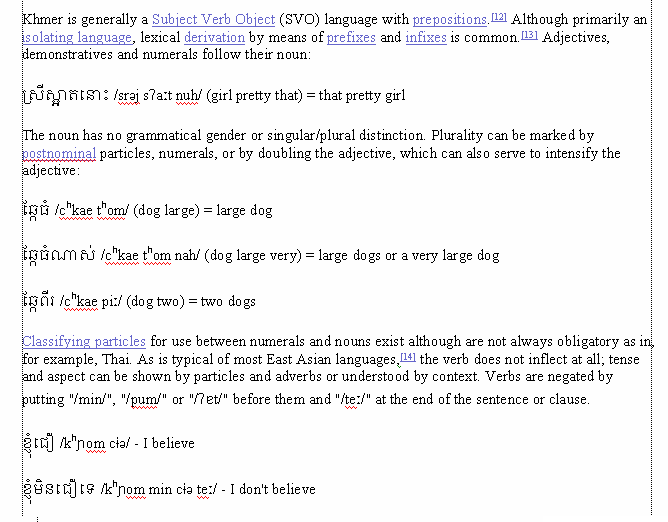
Cambodian or Khmer is the national language of Cambodia, spoken by over twelve million people within the country. Mutually intelligible dialects of Cambodian are also spoken by people living in the Mekong Delta region of Vietnam, Thailand, in the northeastern provinces of Surin, Buriram and Sisaket. Beyond South East Asia there are sizable communities in France and USA, most of whom fled Cambodia during the 1970's. Cambodia belongs to the Mon-Khmer language family. Most of the languages of this family are spoken in Cambodia, Vietnam, Laos and Thailand although a few are found further afield. with the exception of Cambodian, they are minority languages, often spoken in only a few villages. Cambodian is unique in enjoying the status of a national language and is one of the very few Mon-Khmer languages to have a written form and an established literary tradition. Unlike neighboring Vietnamese, Lao and Thai, Cambodian is not a tonal language. It does, however, share many common grammatical features with other major South East Asian languages. Word order in Cambodian follows a familiar subject + verb + object pattern. Native Cambodian words tend to consist of either one or two syllables; but a large number of foreign words have been borrowed from Sanskrit, Pali, Thai and French. For the western learner, perhaps the most notable feature of the language is the lack of verb and noun inflections; indeed, with neither complicated verb tenses nor singular and plural forms of nouns to memorize, Cambodian grammar can be absorbed relatively painlessly. Colloquial Cambodian -David Smyth The Khmer script is used to write Khmer which is the official language of Cambodia. The oldest dated inscription in Khmer, found at Angkor Borei in Takev Province south of Phnom Penh, dates from 611 AD, but Khmer script was probably in use much earlier. Before this the Khmer used a southern indic script (Sanskrit) for several hundred years. Khmer script is probably the oldest writing system among the Southeast Asian cultures next to Mon script. Mon script was developed around the 8th century and Thai script was established in the late 13th century (1292 AD). It is also used to write a few other minority languages in Cambodia who have no form of script of their own. A notable feature of the Khmer alphabet is that it has fewer symbols for vowels than the language has vowel phonemes. Instead, each consonant belongs to one of two series, and the vowel produced depends on which series the consonant belongs to (incidentally making it an abugida rather than a true alphabet). Therefore, most vowel signs have two different possible pronunciations, depending on which series the consonant belongs to. When no vowel sign is present, usually the inherent vowel of the consonant is used. Vowels can be divided into two groups: dependent vowel signs, which are written around a consonant letter, and independent vowel letters, which can stand alone. Dependent vowel signs are used more frequently than independent vowels and all independent vowel letters can be phonetically rendered with a dependent vowel. Khmer also has a number of diacritics, which can change the series of the consonant or change the pronunciation of the vowel. Linguistic study of the Khmer language divides its history into four periods.[4] Pre-Angkorian Khmer, the language after its divergence from Proto-Mon-Khmer until the ninth century, is only known from words and phrases in Sanskrit texts of the era. Old Khmer (or Angkorian Khmer) is the language as it was spoken in the Khmer Empire from the 9th century until the weakening of the empire sometime in the 13th century. Old Khmer is attested by many primary sources and has been studied in depth by a few scholars, most notably Saveros Pou, Phillip Jenner and Heinz-Jürgen Pinnow. Following the end of the Khmer Empire the language lost the standardizing influence of being the language of government and accordingly underwent a turbulent period of change in morphology, phonology and lexicon. The language of this transition period, from about the 14th to 18th centuries, is referred to as Middle Khmer and saw borrowing from Thai, Lao and, to a lesser extent, Vietnamese. The changes during this period are so profound that the rules of Modern Khmer can not be applied to correctly understand the Old Khmer. The language became recognizable as the Modern Khmer spoken today in the 19th century.[4] Khmer is classified as a member of the Eastern branch of the Mon-Khmer language family, itself a subdivision of the larger Austro-Asiatic language group, which has representatives in a large swath of land from Northeast India down through Southeast Asia to the Malay Peninsula and its islands. As such, its closest relatives are the languages of the Pearic, Bahnaric, and Katuic families spoken by the hill tribes of the region.[5] The Vietic languages have also been classified as belonging to this family. Phonology The phonological system described here is the inventory of sounds of the spoken language, not how they are written in the Khmer alphabet.[6] Tone and phonation Most Cambodian dialects are not tonal. However, the colloquial Phnom Penh dialect has developed a marginal tonal contrast (a level vs. a peaking tone) to compensate for the elision of /r/.[7] Khmer once had a phonation distinction in its vowels, which was indicated in writing by choosing between two sets of letters for the preceding consonant according to the historical source of the phonation. However, phonation has been lost in all but the most obscure dialect of Cambodian (Western Khmer).[4] For example, Old Khmer distinguished voiced and unvoice pairs as in *kaa vs *gaa. The vowels after voiced consonants became breathy voiced and diphthongized: *kaa, *ge?a. When consonant voicing was lost, the distinction was maintained by the vowel: *kaa, *ke?a, and later the phonation disappeared as well: [ka?], [ki?].[7 ]
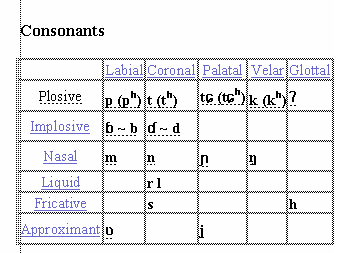
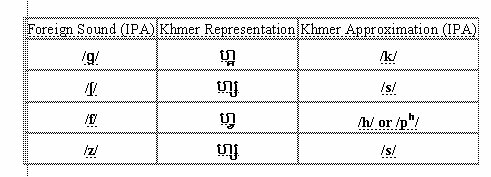
ConsonantsKhmer is frequently described as having aspirated stops. However, these may be analyzed as consonant clusters, /ph, th, t?h, kh/, as infixes can occur between the stop and the aspiration (phem, p
Vowel nuclei
There is little agreement as to the vowels of Khmer. This may be in part because political centralization has not been achieved, so standard Khmer is not prevailing throughout Cambodia. As such, many speakers of even the same community may have different phonological inventories.[9] Two proposals follow:
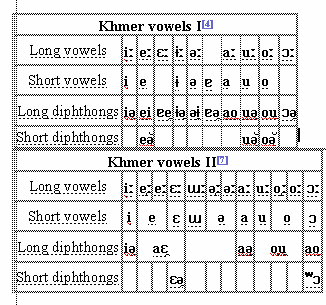
?? The precise number and the phonetic value of vowel nuclei vary from dialect to dialect. Short and long vowels of equal quality are distinguished solely by duration.
Syllable structure
Khmer words are predominantly either monosyllabic or sesquisyllabic, with stress falling on the final syllable.[10] Sesquisyllabic words are phonetically disyllabic, but the vowel of the first syllable is strictly epenthetic and predictable.[11] All disyllabic words are either borrowed, or the result of affixation via non-productive morphological processes.[10] There are 85 possible clusters of two consonants at the beginning of syllables and two three-consonant clusters with phonetic alterations as shown below: 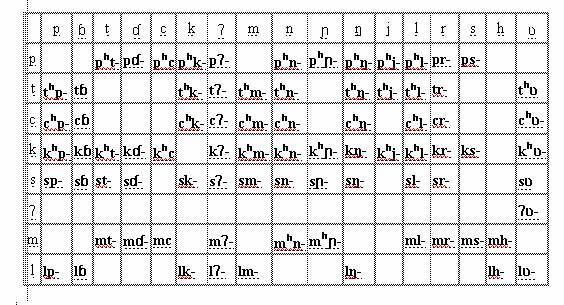
Syllables begin with one of these consonants or consonant clusters, followed by one of the vowel nuclei. The aspiration in some clusters is allophonic.[8] When the vowel nucleus is short, there has to be a final consonant. /p, t, c, k, ?, m, n, ?, ?, l, h, j, ?/ can exist in a syllable coda, while /h/ and /?/ become [ç] and [w] respectively. The most common word structure in Khmer is a full syllable as described above, which may be preceded by an unstressed, “minor” syllable that has a consonant-vowel structure of CV-, CrV-, CVN- or CrVN- (N is any nasal in the Khmer inventory). The vowel in these preceding syllables is usually reduced in conversation to [?], however in careful or formal speech and in TV and radio, they are always clearly articulated. Words with three or more syllables exist, particularly those pertaining to science, the arts, and religion. However, these words are loanwords, usually derived from Pali, Sanskrit, or more recently, French.
Grammar Main article: Khmer grammar