Khmer Religion. Since the ancient time, the Khmers had accepted the two great religions from
Most temples in the Angkor Empire were dedicated to either god Shiva or god Vishnu. Believed to be the holy house of the supreme gods, the temples were carefully built with fine arts, and the materials used are those of everlasting stones. Many impressive sculptures of great craftsmanship were enshrined.
The second religion being revered by the Khmers was Buddhism of Mahayana sect which came into the region quite at same time as Hinduism, however, Buddhism was less prominent.
Both Hinduism and Mahayana Buddhism played an important role as the political, religious and philosophical pillars of Khmer Civilization by which the king was revered as the god-king or deva-raja. This ideology enabled the king to rule over the country as an absolute monarch with sovereign spirituality over his people, and thus enhanced the unity of the kingdom. Successive kings were able to mobilize large manpower to serve the army, to maintain extensive irrigation system and to build numerous massive temples.
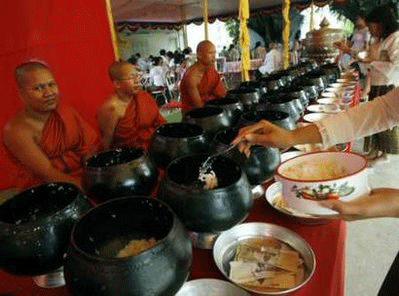
Not until the 13th century, Theravada Buddhism was introduced to the Khmer from
The Khmer people seem to be the obedient students, as they did not raise doubts about the riligious teaching of the original doctrines. We can see in Khmer history that the religions such as Hinduism and Buddhism were not divided into the different sub-sects in the
In addition to Hinduism and Buddhism, the Khmer people also had their own indigenous beliefs such as the local deities, ancestral spirits, as well as the evil spirits. There are no inscriptions or manuscripts to describe these beliefs, however, it can be found to be prevalent in modern
