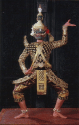
 Traditional Cambodian performing arts Public attention and interest in the cultural development needs of Cambodia have inevitably focused on the plight of the country’s physical cultural heritage, and specifically upon ongoing efforts, sponsored by international agencies such as UNESCO, to safeguard the magnificent Angkor temples in the north west of the country. Comparatively less attention has been given to the problems facing the country’s non-physical heritage, particularly those associated with the traditional performing arts. Recent research has identified many traditional Khmer performing arts genres, including ritual performance, folk music and dance and more than 20 forms of theatre, best known of which are the ancient classical dances associated with the royal court. Not surprisingly, since the techniques of these genres were traditionally handed down by word of mouth, artists had rarely focused on documenting their various forms; the masters of one generation simply taught the next. However, the great majority of Cambodia’s artists perished under the Pol Pot regime, and with them went over half of the performance disciplines. After the war in 1979, radio announcements were made in an attempt to locate surviving performers around the country, with the goal of identifying which forms might still be practised. Some nine disciplines were eventually resurrected and since that time the Cambodian government, in conjunction with international agencies such as UNESCO, has made strenuous efforts to widen the practitioner skills base of these ancient art forms. Use the navigation bar on the left to read more about the traditional Cambodian performing arts or make direct contact with organisations and individuals working in this sector through our KEY CONTACTS database.
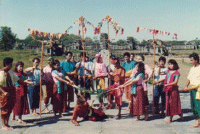
 Proto-theatrical activity The oldest extant Cambodian performance genres are those which, in accordance with the general South East Asian pattern, function for entertainment, social integration and spirit propitiation in rural society. These include the singing of verse epics and poetry, as well as trance dances and ceremonies connected with ancestor worship and animist beliefs. Ritual origins may be discerned in the port ruong or ruong tree spirit-worshipping dance of Koh Kong Province, the nang meo rain dance of Siem Reap, and the trott or stag dance of Siem Reap and Battambang. In the latter, dancers impersonating deer and hunters travel with their musical accompaniment from house to house, dancing and collecting payment in order to bring prosperity for the new year. Cambodia supports numerous other important proto-theatrical styles. Trance-dances are still performed at a few rural shrines in the north of the country and sung-storytelling is preserved in the form of chapei, named after the lute which accompanies it. More widely found today is the call-and-response folk chant known as lakhaon ayai, which takes the form of a verbal battle of the sexes – largely improvised, although it is based on a written text – performed along with simple dance movements to the accompaniment of the khoeum (zither) or the tro (two-stringed fiddle). In many ways lakhaon ayai is not dissimilar to certain types of lam in neighbouring Laos. Both chapei and lakhaon ayai traditionally interpreted ancient legends, but today they frequently draw their subject matter from topical events and in this way are often utilised by politicians wishing to spread their message. As elsewhere in the region, age-old proto-theatrical activities may well have provided a basis for later classical styles developed under external influences during the first millennium CE.
Development of the Khmer classical performance tradition Court musicians from the kingdom of Funan formed part of a diplomatic mission sent to the Chinese emperor as early as 243 CE, and during the 6th century female dancers were dedicated to the Hindu temples of Chenla. Although the exact nature of pre-Angkorian music and dance remains unclear, the significant increase in international trade which characterised the period would have brought both Indian and Chinese influence strongly to bear on all forms of cultural expression within the region. The extent of Chinese cultural infiltration during the first millennium CE was not insignificant and may be perceived today in many aspects of Khmer music, not least the widespread use of instruments of sinitic derivation such as the moon-shaped lute known as the chapei (equivalent to the Chinese yue qin), the two-stringed fiddle known as the tro (equivalent to the Chinese hu qin) and the 14-stringed zither known as the khoeum (equivalent to the Chinese zheng). However, the most important influence in the emergence of a Khmer classical performing arts tradition, both directly and by way of the Indonesian archipelago, was that of India. The Khmer courtly music and dance performed today originated with the sponsorship of the Angkorian monarchs from the 9th century onwards. Jayavarman II (802-850), founder of the Angkorian kingdom, is generally credited for the introduction into Cambodia of the Indian devaraja (god-king) cult practised there, along with its associated performance genres. Female courtly dance was probably an integral part of the ritual to enhance the presumed magico-religious powers of the king – through their performance, the harem of royal wife-dancers in effect celebrated the union of the ruler and divine power, linking him to the chthonic forces of earth and fertility. 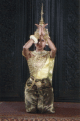
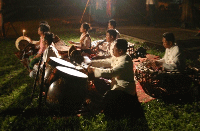
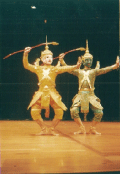
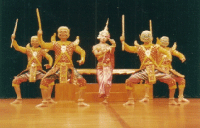
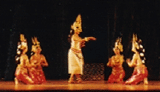
As elsewhere in South East Asia, the Hindu Ramayana and (to a lesser extent) Mahabharata epics and the jataka (lives of Boddhissatva kings and princes) were source materials for dance-drama and other courtly theatre genres such as male masked dance and shadow theatre. Cambodian classical dance or lakhaon kbach boran is featured extensively on the bas-reliefs of the Khmer temples. Its most important and sacred form is the robam apsara or 'heavenly' female dance-drama, which today comprises some 60 pure dance pieces and 40 dance-dramas. In the latter the dancers mime the action while a chorus of female singers delivers the text to the accompaniment of a pinpeat ensemble (see below). The Khmer female dance has much in common with its Thai and Lao derivatives, but is characteristically slower, subtler and generally more representative of an act of worship. In 2003 Lakhaon kbach boran was recognised by UNESCO as a Masterpiece of the Oral and Intangible Heritage of Humanity – at the time one of only 47 art forms worldwide to receive this recognition. The female dance is complemented by a masked male dance-drama known as lakhaon khaol, which takes its storyline from the Raemker, a Khmer version of the Ramayana commissioned during the early Angorian period. Essentially a moral tale, the Raemker describes the adventures of Prince Rama, an incarnation of the god Vishnu. Before Rama's birth the gods determined that his life would be one of a hero, but that he would be tested by various trials and tribulations. Renouncing his throne, the prince is banished and wanders in the wilderness for many years with his beautiful wife Sita and his brother Lahksman. Sita is abducted by the evil King Ravana, but Rama eventually finds her with the help of Hanuman, King of the Monkeys and son of the God of the Wind. In lakhaon khaol male dancers played both male and female roles; over the centuries a lesser-known female version of the genre known as lakhaon paol srei also developed. Both lakhaon kbach boran and lakhaon khaol involve singing and the recitation of narrative verses by a chorus sitting with an accompanying pinpeat ensemble (see below). The aesthetics and repertoire of lakhaon khaol betray its origins as a human development of that other important classical genre, the puppet play. Cambodia preserves two main types of shadow puppetry – sbek toch or 'little skin', which uses small, cut and jointed leather figures akin to those found in its Javanese progenitor wayang kulit, and sbek thom or 'big skin', a unique form in which large engraved two-dimensional leather puppets with no moving parts are manipulated both in front of and behind a screen by dancing puppeteers. In 2005 sbek thom was recognised by UNESCO as a Masterpiece of the Oral and Intangible Heritage of Humanity. In recent years experts at the Ministry of Culture and Fine Arts have revived a related third form of puppetry known as sbek por, which is presented in daylight using medium-sized coloured leather puppets with no moving parts. 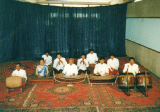
Whilst gongs and metallophones were probably introduced into Cambodia at a much earlier date, the pinpeat, a dedicated musical ensemble associated most closely with all types of Khmer classical performance, is believed to have developed at the Angkorian court. Comprising a maximum of 10 musicians, it shares many structural features with the gamelan of the Malay world on which it was based, bringing together various-sized graded gong chimes set into circular rattan frames known as khong wong with wooden xylophones known as roneat, metallophones, suspended gongs, drums, cymbals and wind instruments such as the double-reed oboe known as the sralai (formerly called pi shanai). The pinpeat gave rise to other types of Khmer ensemble, including the khlang chnak and phlaeng knong schoor orchestras, which are associated with funeral rites, and the string-dominated phlaeng mahaori orchestra, which was traditionally associated with temple ceremonies and offerings to the gods. The pinpeat is believed to have been the inspiration behind the Thai and Lao piphat and the Burmese hsiang. In subsequent centuries, as the power of Angkor declined and the Siamese, Vi?t, Lao and Burmese struggled for ascendancy in the region, the rulers of Siam, Lane Xang (Laos) and Burma – each keen to replicate the former glories of Angkor in their own dominions – sought to encourage the spread of similar performing arts traditions. It is in this way that the Thai, Lao and Burmese female and masked male dance-drama and Thai and Lao shadow puppet traditions are thought to have been established. The story was to come full circle in the 19th century, when Khmer King Ang Duong (1796-1859) sought to restructure Cambodian court performance with the assistance of experts from Thailand
 It is interesting to note that the political significance of the female classical dance, which linked the ruler with the world of the ancestors and spirits and thus assured him of god-like powers, was recognised even by the French colonial administration – its decision in 1928 to transfer the royal company to the charge of the École des arts Cambodgiens (forerunner of the Royal University of Fine Arts) was clearly made with a view to being seen to exercise their rights according to the old adage that he who controlled the dance controlled the nation. The royal troupe was dissolved in 1942 by the Vichy government but revived in 1948. Something of a renaissance in the female and male masked dance tradition took place during the Sangkum Reastr Niyum period, when Queen Sisowath Monivong Kossomak Neary Rath Vattana, mother of King Norodom Sihanouk, took over the administration of the court troupe, revitalising and streamlining its repertoire. With the construction of new theatre auditoria in major centres of population during the 1960s, the so-called ‘Cambodian Royal Ballet’ began performing regularly, for both domestic audiences and tourists. During this period the troupe also became a highly successful vehicle for international cultural diplomacy, giving performances at official receptions and undertaking several successful performance tours overseas.
In the aftermath of the tragedy of 1975-1979 the few surviving members of the former royal dance troupe slowly regrouped. By 1980 the company had been transferred, as in neighbouring Thailand, to the control of the government. It has since operated as but one component of the National Theatre Company, which has also revived the once courtly art of shadow puppetry (long since relegated to the status of a village art in Cambodia) in addition to maintaining a commitment to other forms of Khmer theatre, including the folkloric and circus arts. In this connection it should be mentioned that, since the national classical dance troupe is no longer directly associated with the palace, it is technically incorrect to refer to it as the ‘Cambodian Royal Ballet’, although foreign promoters still tend to do so when publicising foreign tours. 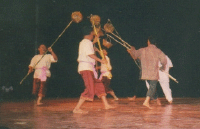
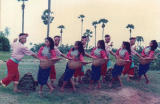
Folkloric music and dance The folkloric tradition in Cambodia has also given rise to a number of different performance genres which draw heavily on the court traditions with which they have interacted over the centuries, using common source material such as the Ramayana, the Javanese panji cycle, jataka stories and local mythology. Unfortunately many of these genres, such as the folk theatres lakhaon pramochtei and lakhaon boeuk bot, have now virtually disappeared. Several current overseas-funded initiatives are attempting to identify funds to revive some of these lost forms while the few living masters – or at least students of those masters – are still with us. Each region also has its own unique folk dance traditions, invariably linked to local ceremonies and special days. As in many other parts of Asia, most of the 'Khmer folkloric dances' (robam prapeyney) currently performed by the National Theatre Company are actually of fairly recent origin. A number of these were choreographed at the Royal University of Fine Arts in the 1960s, whilst others were devised during the same period by Prince Norodom Sihanouk himself for presentation to tourists. However, many of these folkloric dances are nonetheless based on older forms created to celebrate key periods of the year such as harvest or new year, times of group games when young men are ‘officially’ allowed to flirt with the opposite sex. As in neighbouring Thailand and Laos, ‘popular dances’ (robam pracheaprey) spread rapidly throughout the country during the early years of the 20th century. The best-known popular dances are the ubiquitous group circle dance known as ram vong and a related style known as ram kbach. 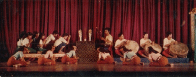
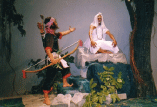
Folkloric theatre At the turn of the 20th century there began to emerge popular South East Asian drama forms with an emphasis on plot and dialogue, performed in permanent theatres for a ticket-buying audience. An important catalyst for this development was the appearance of itinerant bangsawan touring theatre troupes from Malaysia, presenting a new style of theatre in which entertainment was the primary aim. The folkloric theatre genre lakhaon yike is believed to have developed under the influence of touring bangsawan companies, but it also parallels Thai likay and Malay jikey in its mixture of classical and modern choreography and costuming and as such is thought to have the same basic origins. Recounting ancient tales of the Khmer kings, yike performers alternate between highly dramatic modes of speaking and singing, to the accompaniment of an ensemble made up of traditional Khmer instruments. Another important folkloric theatre style of this period is lakhaon bassac, which originated with the itinerant river-borne theatre groups of Cambodia and southern Vi?t Nam in the early years of the 20th century – travelling up and down the Bassac-H?u Giang River in large sailing boats, these troupes would pull in to give performances at major centres of population. Strongly reminiscent of Chinese opera, the genre incorporates numerous influences, including that of the Vietnamese classical theatre tu?ng (there were groups in southern Vi?t Nam from 1908 to 1939), Khmer theatre and even Hindi and western movies. It is presented to the accompaniment of popular music performed on both traditional and modern instruments. The folk opera lakhaon apei, often described as a mixture of yike and classical dance, was also devised in the early years of the present century, but had more or less vanished from Cambodia by the 1940s. The version currently performed by the National Theatre Company in Phnom Penh is believed to have been devised during the post-colonial era and is a very modern form which, unlike most types of Cambodian performance, usually involves some kind of contemporary dress and modern-style music. Traditional versions of both lakhaon bassac and lakhaon apei have been researched and are occasionally performed by the Kompong Cham Provincial Performing Troupe. A loosely-scripted folkloric dance-drama known as lakhaon mahaori had also appeared by the 20th century. This genre draws its melodies from the ancient ceremonial music known as phlaeng mahaori; as noted earlier, the mahaori orchestra which accompanies the action is dominated by stringed instruments, specifically the tro and the three-stringed zither of Mon origins known as the takhe (literally ‘crocodile’, a reference to its distinctive shape).
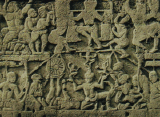
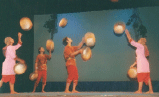
Circus As evidenced by the bas-reliefs of the Khmer temples, circus is one of Cambodia’s most ancient performing arts genres. Acrobats, jugglers and other circus acts were traditionally an important feature of both courtly and itinerant Khmer theatre troupes and today the circus remains one of the country's favourite forms of entertainment. As in neighbouring Vi?t Nam and Laos, close links with the former Soviet Bloc and the People’s Republic of China have helped to enhance technical skills in the genre, raising the profile of the circus arts in Cambodia. However, the continued presence of indigenous elements of dance and music ensure its uniqueness as an authentic Cambodian discipline. In 2003 a private American donor commissioned the Royal University of Fine Arts to create a full-length circus performance, incorporating pure Cambodian techniques based on research of the bas-reliefs. This project helped to revive traditional Khmer circus and contribute to its ongoing survival, as the piece is now an important part of RUFA’s current repertory and will be performed as often as possible.  Ethnic minority music and dance Each of the ethnic minority groups residing within Cambodian borders has its own unique music and dance traditions, which function together with the production of art objects to propitiate the spirits and celebrate the many social milestones in the lives of members of the community. While important differences exist in the music of the ethnic minority communities, all of them share a common instrumentarium, crafted with great ingenuity from natural materials such as stone, wood, gourd, bamboo, animal horn and reed to accompany a wide range of solo and group songs and dances. In common with their cousins in southern Laos and the central highlands of Vi?t Nam, the Steang of Kratie Province and several other ethnicities also utilise bronze drums as an integral part of their ritual ceremonies.

